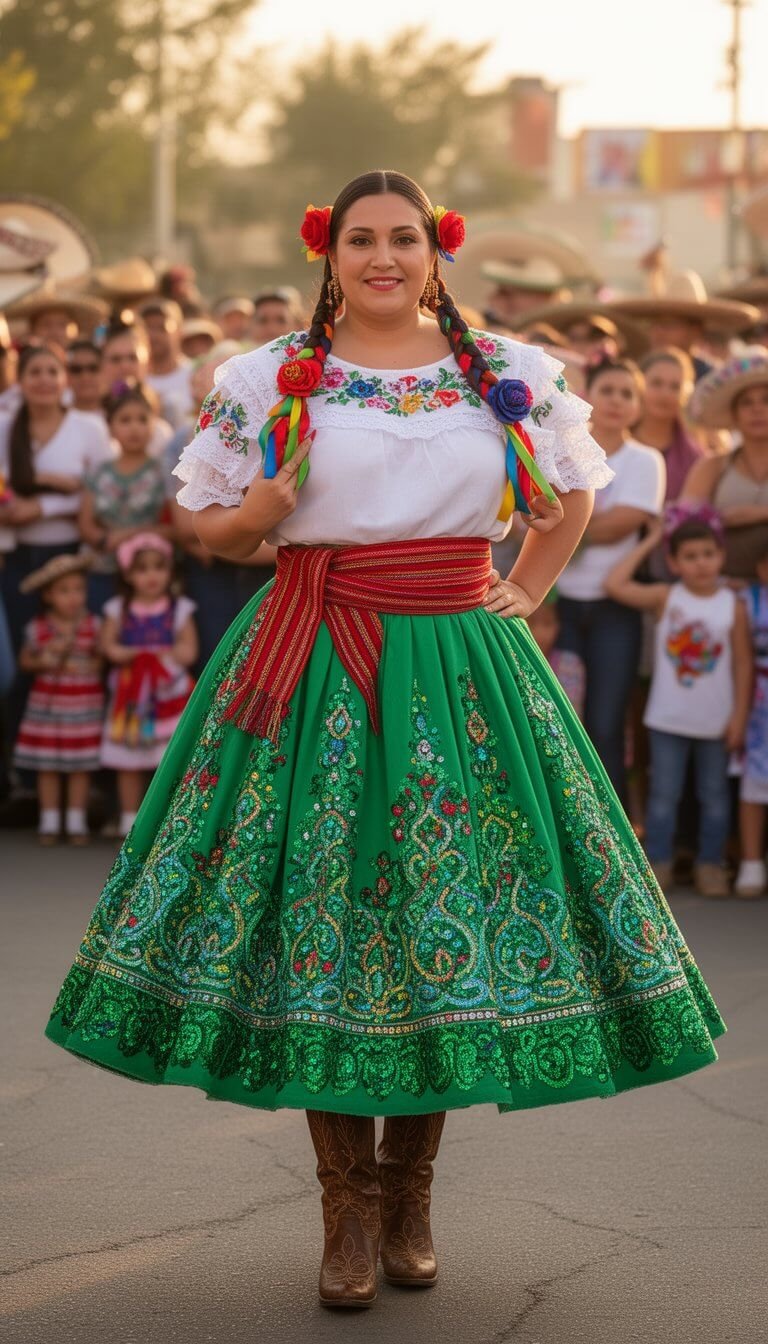
Cinco de Mayo is not Mexican Independence Day. That distinction matters before anything else in this guide, because how you understand the holiday shapes how you dress for it.
The fifth of May commemorates the Battle of Puebla in 1862, a genuine historical moment of Mexican resistance, and it carries cultural weight that a sombrero-and-poncho party costume doesn’t come close to honoring.
What celebration without appropriation actually looks like in practice is more interesting than the alternative anyway.
It means color used with intention, silhouettes rooted in real Mexican and Chicana fashion traditions, support for Latina designers who are doing some of the most exciting work in contemporary style, and an understanding that dressing for a cultural occasion is an act of engagement rather than performance.
Every look in this guide was built around that understanding. None of them requires a costume. All of them require thought.
1. The Embroidered Mexican Blouse Worn as the Hero Piece
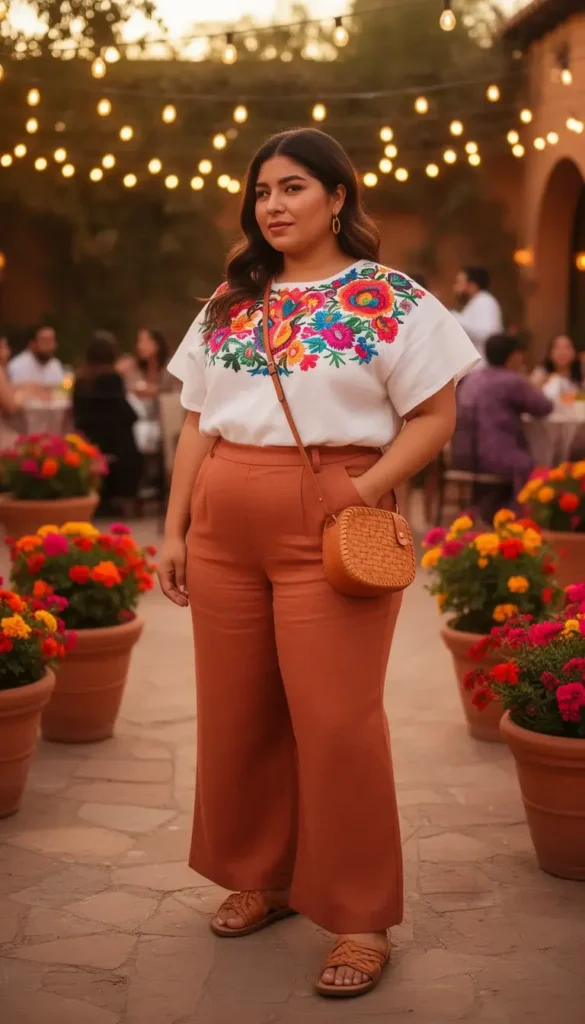
The hand-embroidered blouse, whether a huipil from Oaxaca, a bordado from Puebla, or a Tenango-style piece from Hidalgo, is one of the most significant garments in Mexican textile tradition.
Each region has its own stitch vocabulary, color logic, and symbolic language embedded in the embroidery patterns, which means wearing one is an act of recognition rather than appropriation, particularly when the piece is sourced from Mexican artisans or Latina-owned boutiques that work directly with indigenous makers.
The styling move that honors the blouse is simplicity below the neck.
A wide-leg linen trouser in a warm earth tone, a clean midi skirt in a complementary solid, or high-waisted wide-leg jeans all allow the embroidery to hold its position as the visual center of the look. Nothing should compete with the textile’s own story.
Buying from the source matters here in a way it doesn’t for purely commercial fashion.
Organizations like Manos de Oaxaca and contemporary Latina designers such as Johanna Ortiz, who incorporates Mexican textile traditions into luxury ready-to-wear, offer paths to these pieces that directly support the communities whose craft they represent.
2. The Tiered Ruffle Dress in a Fiesta Color
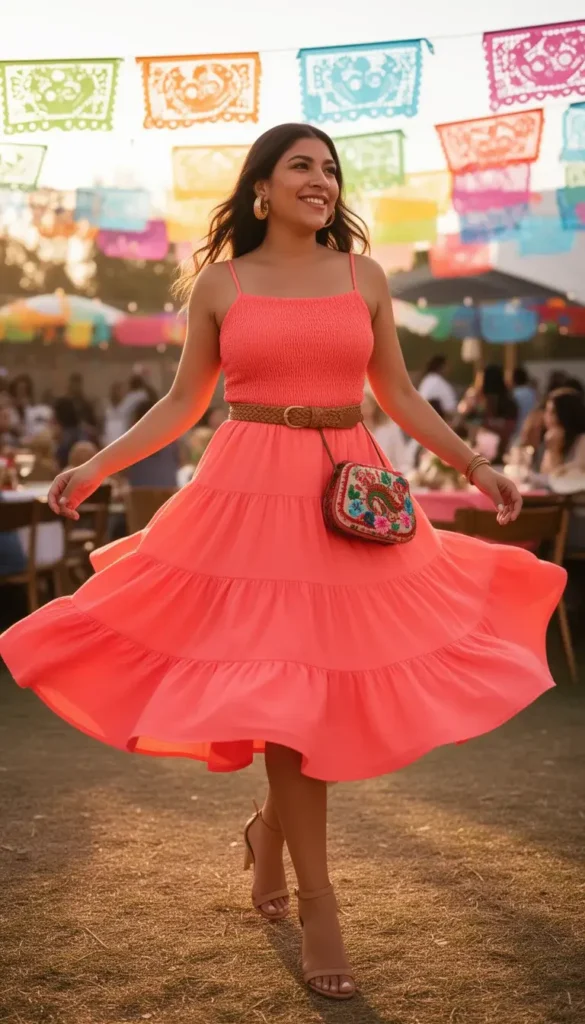
The tiered ruffle dress has deep roots in Mexican regional dress, appearing across Jalisco, Veracruz, and Oaxacan fashion traditions in forms that predate its current mainstream popularity by centuries.
Wearing a contemporary version of this silhouette on Cinco de Mayo is an engagement with a living fashion lineage rather than a costume reference, provided the styling choices around it stay grounded.
Colors matter here more than in almost any other outfit category. The palette of Mexican folk art and festive dress runs toward warm saturation: coral, marigold, cerulean, deep rose, vivid jade, and the kind of red that reads as full commitment.
These are not coincidental color choices. They reference the visual culture of Mexican celebration in a way that muted or pastel interpretations of the same silhouette simply don’t.
The tiered ruffle dress moves. Selecting this silhouette for an outdoor Cinco de Mayo celebration with space to dance is choosing an outfit that will look better as the evening progresses, since the tiers catch movement and create their own visual interest that static poses can’t fully reveal.
3. The Floral Crown Reference That Honors Its Source
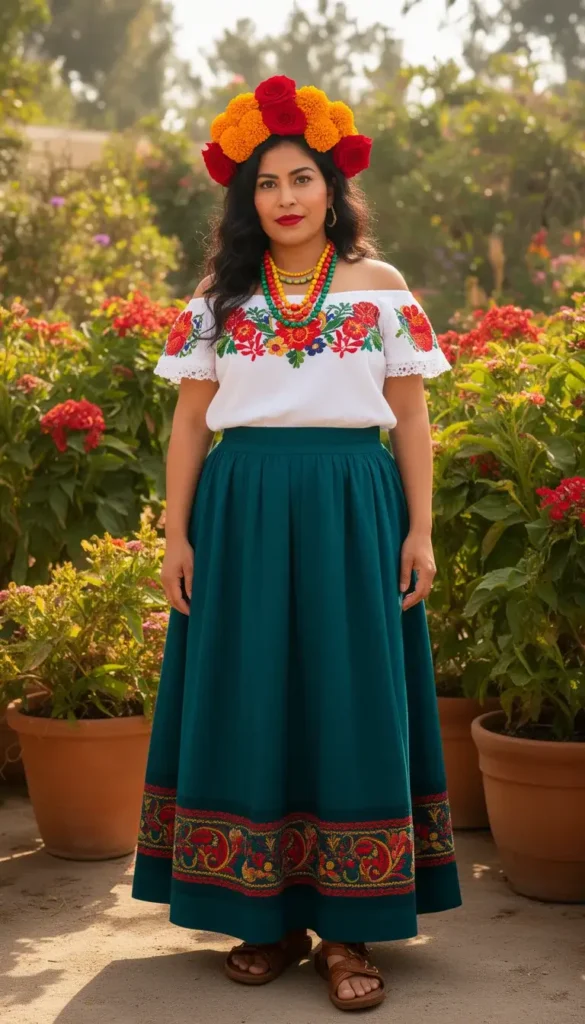
Frida Kahlo’s floral crowns are among the most recognized personal style statements in art history, but they weren’t invented by Frida.
She drew from Tehuana traditional dress, specifically the elaborate headdress traditions of Tehuantepec women in Oaxaca, a matriarchal society whose fashion Frida wore as a political statement of indigenous Mexican identity and feminist pride.
Understanding that context changes how the floral crown functions as a Cinco de Mayo styling choice.
Worn with genuine Mexican garments, earthy natural flowers rather than plastic imitations, and a clear aesthetic engagement with the broader Tehuana or regional tradition it references, the floral crown is a form of cultural celebration.
Worn as a Halloween-style accessory over an otherwise disconnected outfit, it’s extraction.
Fresh marigolds are the most culturally resonant flower for a Cinco de Mayo crown because marigolds are cempasúchil, the flower of Día de los Muertos, and Mexican ceremonial tradition broadly.
Their presence in a styling context rooted in Mexican culture is meaningful rather than arbitrary.
4. The Latina Designer Dress as Direct Cultural Investment
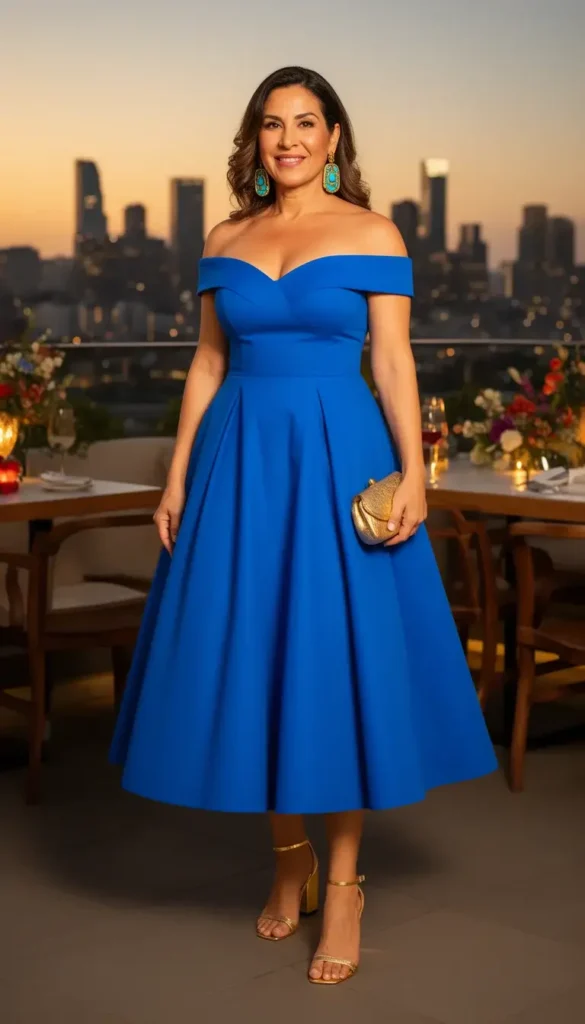
One of the most direct ways to celebrate Cinco de Mayo through fashion is to spend money in the direction you’re celebrating.
Mexican and Mexican-American designers are producing some of the most vibrant, culturally grounded, and genuinely excellent women’s fashion available anywhere in the contemporary market.
Carolina Herrera, who brings Venezuelan and broader Latin American influence to her work. Alejandra Alonso Rojas, whose Colombian-American perspective produces sculptural luxury that references Latin American craft traditions.
Isabel Marant, who has drawn extensively and controversially from Mexican embroidery traditions, contrasts with designers like La Libertad, who pay indigenous communities directly for their work.
For accessible price points, Chicana-owned brands operating out of Los Angeles, San Antonio, and the borderlands region specifically design for Cinco de Mayo and Mexican American celebrations with an insider understanding that mainstream fashion brands cannot replicate.
The cobalt and turquoise palette that defines this outfit references Mexican artisanal color traditions, specifically the blue-on-blue color language of Talavera pottery from Puebla, the very city whose battle Cinco de Mayo commemorates.
5. Marigold Yellow as a Culturally Resonant Color Choice
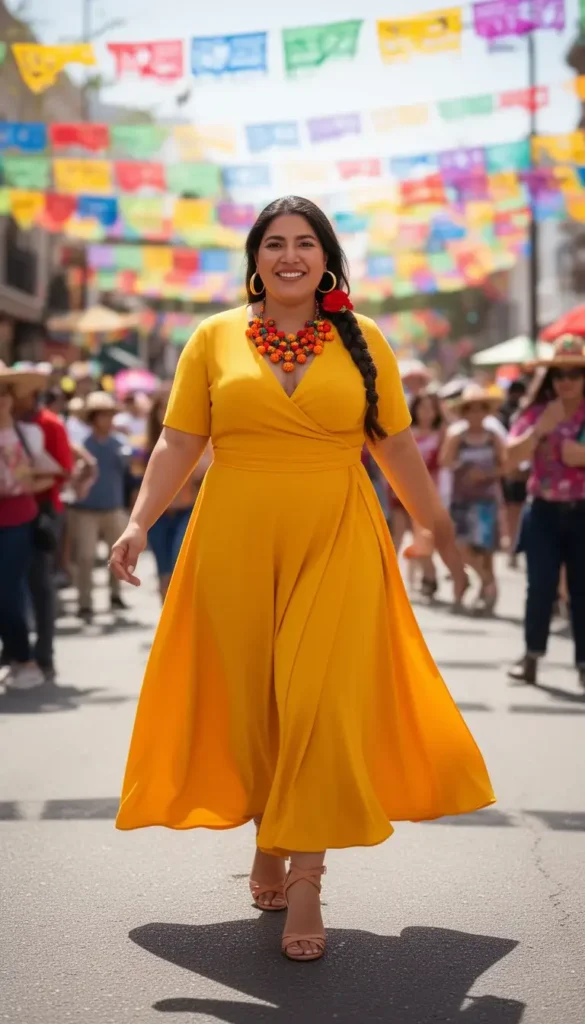
Marigold is not just a color that happens to look good in Mexican celebration contexts.
Cempasúchil, the Mexican marigold, is the flower most deeply associated with life and death in Mexican cultural tradition, appearing across Día de los Muertos altars, religious ceremonies, and celebrations throughout the country.
Wearing marigolds on Cinco de Mayo is a color choice with genuine cultural roots rather than arbitrary vibrancy.
The wrap dress silhouette in this shade works because it moves the way celebration dressing should. The deep V-neckline, the full skirt, and the fabric’s response to movement all work with the cultural energy of an outdoor fiesta rather than against it.
Accessories in hand-beaded formats, particularly those sourced from Mexican artisan communities in Chiapas or Oaxaca, add a layer of craft engagement that mass-produced accessories cannot provide.
Beaded jewelry from these regions represents weeks of skilled labor, and wearing and purchasing it is a form of direct economic support for communities that create it.
6. Tehuana Dress Tradition in a Modern Context
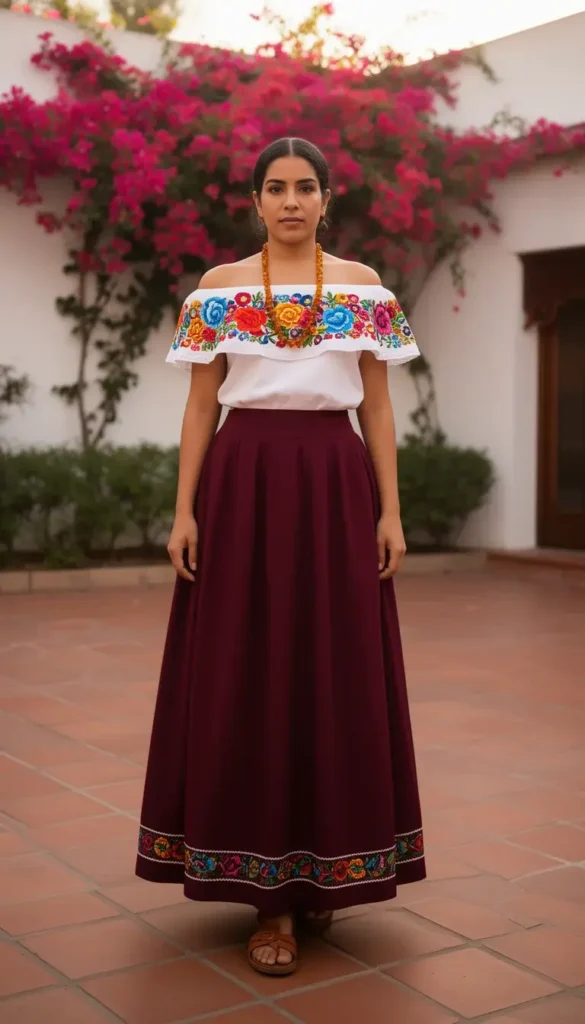
The Tehuana dress tradition from the Isthmus of Tehuantepec in Oaxaca is one of the most visually extraordinary regional dress traditions in Mexico and one of the most frequently misappropriated.
Frida Kahlo’s adoption of the Tehuana dress as a political statement brought it global visibility, which has been both a gift and a complication for the Tehuantepec women whose cultural heritage it represents.
Engaging with this tradition respectfully means understanding its origin, purchasing pieces from Oaxacan makers rather than mass-produced imitations, and wearing it with a genuine aesthetic commitment to the whole rather than extracting a single decorative element like the embroidery pattern for use on an otherwise unrelated garment.
The off-shoulder Tehuana blouse worn with a full long skirt in a jewel tone is the most grounded contemporary interpretation of this tradition.
The silhouette is historically accurate, the embroidery is the design story, and the accessories, amber beads particularly, reference the jewelry tradition of Oaxacan women rather than substituting a generic gold chain.
7. Color-Blocking With the Mexican Folk Art Palette
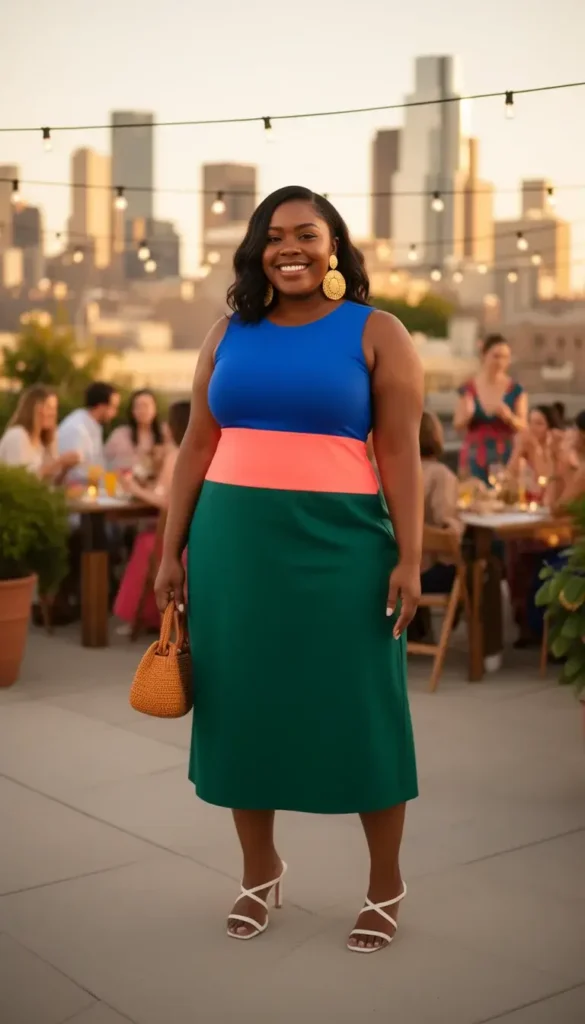
Mexican folk art, from Talavera ceramics to Huichol beadwork to Oaxacan alebrijes, operates from a color philosophy that places vivid, unexpected colors in direct adjacency, creating combinations that Western minimalism tends to avoid but that Mexican visual tradition has refined over centuries into something that reads as sophisticated rather than chaotic.
Cobalt next to coral next to jade is not an accidental combination. It’s drawn from the color logic of Talavera pottery, which places those specific tones together so consistently that the grouping reads as a cultural reference to anyone familiar with the tradition.
Color-blocking a dress in this palette is an act of visual literacy rather than random vibrancy.
This approach works for Cinco de Mayo because it demonstrates engagement with Mexican visual culture at a level beyond the surface, showing that the wearer has observed and absorbed something genuine about how color functions within this tradition rather than simply reaching for any bright combination.
8. Huaraches as the Culturally Grounded Shoe Choice
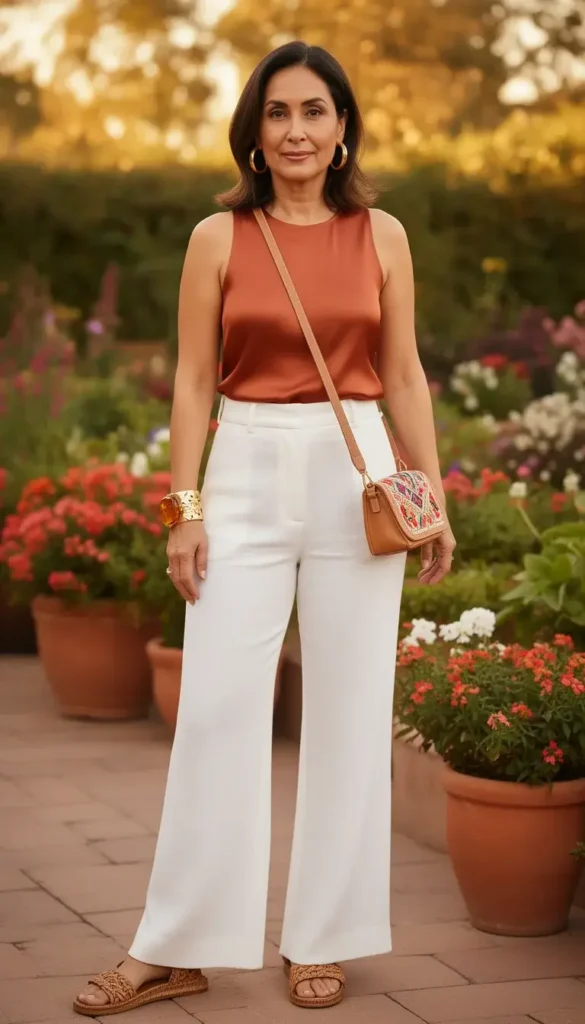
The huarache sandal is one of the most historically continuous garments in Mexican fashion, with a manufacturing tradition tracing back to pre-Columbian Mesoamerica and a continuous presence in Mexican daily and ceremonial dress ever since.
Contemporary huaraches from Mexican artisan makers in Jalisco, Yucatán, and Oaxaca are hand-woven in leather or natural fiber using techniques passed through family workshops across generations.
Wearing authentic huaraches to a Cinco de Mayo celebration is footwear as cultural engagement.
The distinction between authentic artisan-made huaraches and the mass-produced imitations sold at fast fashion retailers matters in exactly the same way that the distinction between authentic embroidered blouses and machine-printed facsimiles matters.
One supports the tradition. The other extracts its aesthetic while bypassing the community that created it.
Pair huaraches with modern elevated separates, linen trousers, silk tanks, structured skirts, and the sandal bridges contemporary styling with a genuinely ancient Mexican craft tradition in a way that reads as considered rather than costumed.
9. Contemporary Embroidery-Print Dresses That Reference Authentically
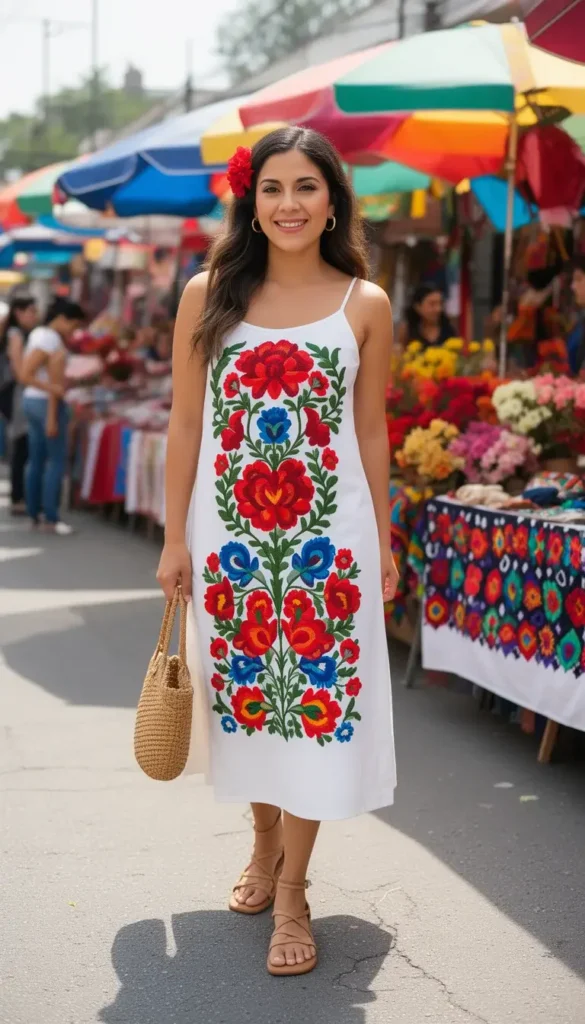
Mexican embroidery traditions have entered the mainstream fashion print vocabulary in the last decade, which creates both opportunity and responsibility.
When a brand prints a pattern inspired by Tenango de Doria needlework, the question worth asking is whether that brand is crediting and compensating the Otomi artisan community of Hidalgo, whose visual language they’re drawing from, or simply appropriating a decorative aesthetic for commercial use.
Brands that handle this well, specifically noting their source communities, collaborating with artisan cooperatives, and contributing royalties or licensing fees back to those communities, produce print dresses that are worth wearing to Cinco de Mayo as a genuine expression of cultural engagement.
Brands that simply lift the aesthetic without credit or compensation produce pieces that, however visually similar, function differently as cultural objects.
The dress itself, a cotton sundress in a white base with vivid floral embroidery-inspired print, is a genuinely beautiful Cinco de Mayo option.
Whether it earns a place in a respectful celebration depends entirely on whose hands made the decisions that put it into production.
10. Chicana Street Style as Its Own Tradition
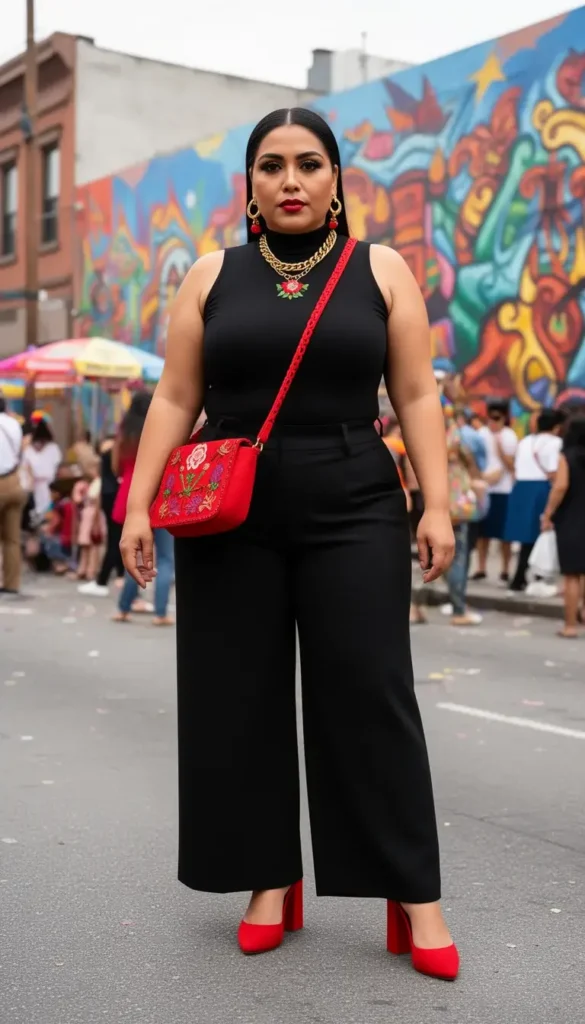
Chicana fashion is a distinct aesthetic tradition that is simultaneously Mexican, American, and entirely its own thing.
It draws from pachuca and zoot suit culture of the 1940s, East Los Angeles fashion lineages, Chicano civil rights movement aesthetics, and contemporary Latina streetwear in ways that are continuously evolving and entirely legitimate as cultural expression.
Dressing in Chicana street style for Cinco de Mayo, particularly as a Mexican-American woman, is an act of self-representation rather than appropriation.
Black and red as a color combination, bold gold jewelry, red accessories with clean silhouettes, and the specific way Chicana fashion incorporates embroidered detail into otherwise urban looks all reference an American-born cultural tradition with as much depth and historical grounding as any Mexican regional dress.
For non-Mexican-Latina women engaging with this aesthetic, the appropriate response is admiration and engagement rather than wholesale adoption. Wearing one element thoughtfully while understanding its context is very different from performing an identity wholesale.
11. The Serape Jacket Worn Correctly
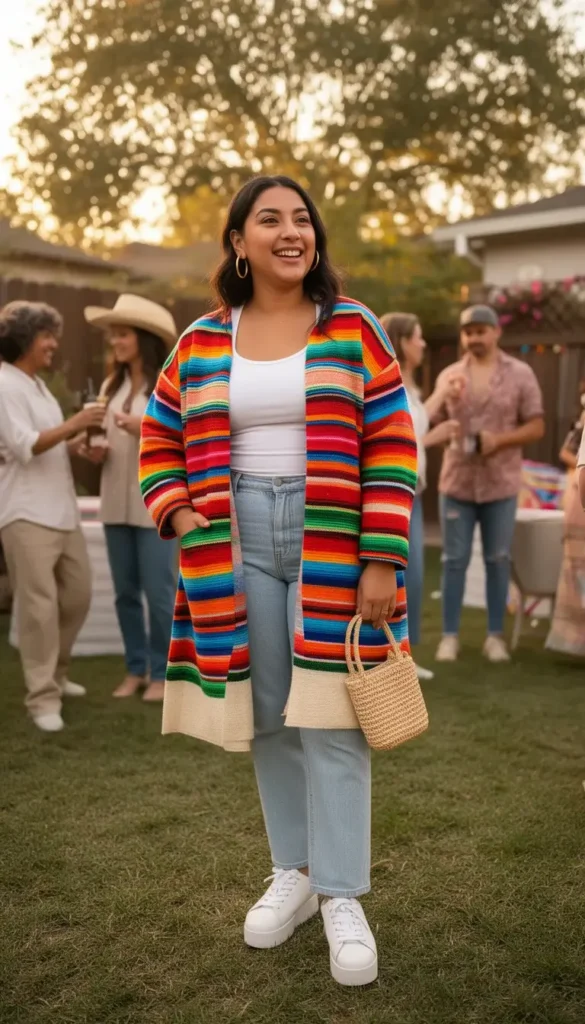
The serape, the brightly striped woven wool blanket produced primarily by Saltillo weavers in Coahuila and throughout central and southern Mexico, is one of the most recognizable Mexican textile traditions globally and one of the most frequently reduced to costume shorthand.
A serape poncho worn as part of a Halloween-level costume is appropriation. An authentic hand-woven serape jacket purchased from a Mexican weaving cooperative and styled as part of a genuine outfit tells a completely different story.
The distinction between these two uses is not purely symbolic. Authentic Saltillo serapes represent weeks of skilled weaving labor and a design tradition with centuries of regional specificity.
Purchasing one from the cooperative that produced it, wearing it as genuine outerwear rather than a costume prop, and being able to speak to its origin when asked is the full expression of what respectful cultural engagement with this piece looks like.
Styled open over a fitted white tank and jeans, the serape jacket functions as exactly the kind of statement outerwear that any other distinctive jacket would, while carrying a material and cultural depth that no mass-market alternative provides.
12. The Ruffle Maxi Skirt and Crop Top Combination
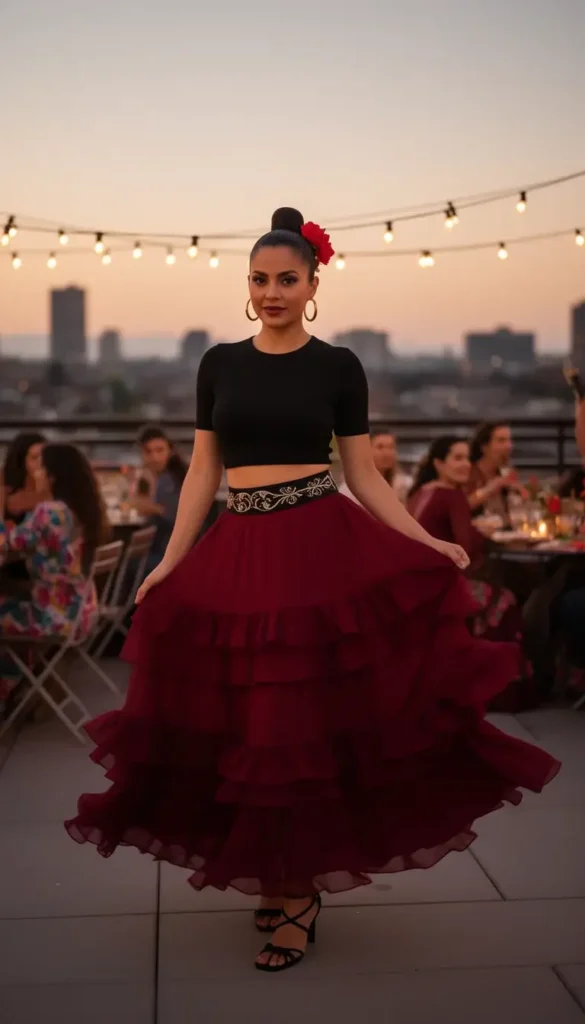
The pairing of a full ruffle maxi skirt with a fitted crop top is one of the most modern expressions of a silhouette that runs continuously through Mexican regional dress from Veracruz to Jalisco.
The skirt’s ruffle tiers reference the Veracruz jarocha tradition, where dancers in white and red ruffle skirts perform the zapateado on wooden platforms, while the contemporary crop-top pairing places it firmly in the present.
Deep red is the most historically loaded color choice here, referencing both the visual language of Mexican celebration and the rose that is Mexico City’s symbolic flower. Paired with black, which runs throughout Oaxacan and urban Mexican fashion tradition as a grounding neutral, the combination reads as culturally aware rather than coincidentally vibrant.
The sleek high bun with a single flower is a restrained reference to the elaborate hair traditions of Mexican regional dress without attempting to recreate a specific cultural style that would require a deeper personal connection to wear authentically.
13. Puebla-Style Embroidery as the Appropriate Cinco Reference
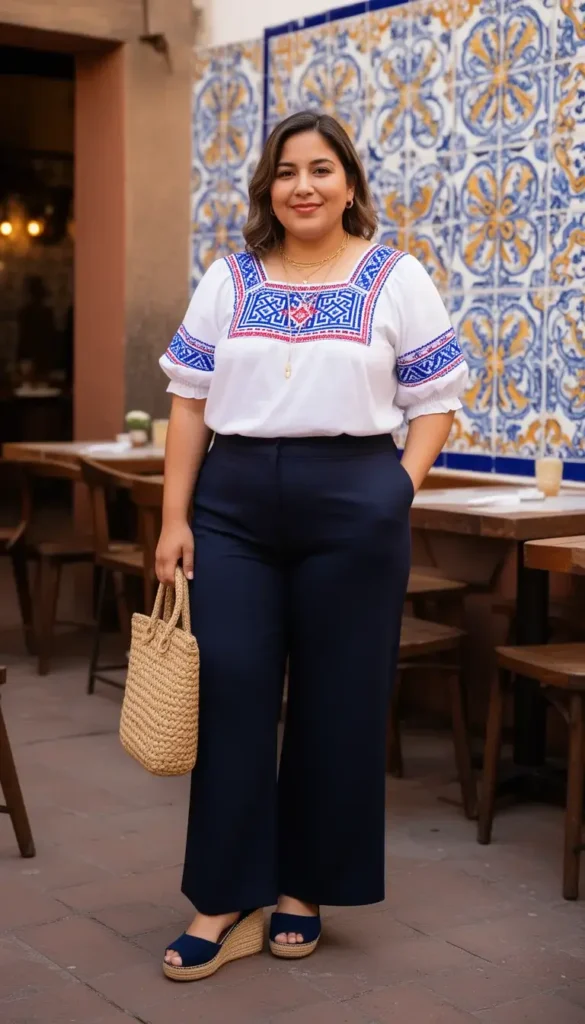
Since Cinco de Mayo celebrates the Battle of Puebla, the embroidery traditions of Puebla state carry a specific and appropriate resonance for this particular holiday.
Puebla embroidery, with its characteristic geometric patterns in blue and red on white fabric, appears on traditional clothing throughout the region and represents a textile tradition that is actively maintained by Poblana artisan communities today.
Wearing Puebla-style embroidery on Cinco de Mayo is the most historically specific cultural connection available in fashion terms, linking the garment directly to the place the holiday commemorates.
This specificity is worth understanding and being able to articulate, since it transforms the outfit from a decorative choice into a genuine cultural engagement.
The combination of a Puebla blouse with contemporary separates like wide-leg trousers and espadrilles reflects a modern Mexican woman’s way of wearing these traditional elements, which is exactly the aesthetic register that honors tradition without recreating it as a museum exhibit.
14. Elevated Mexican Fashion for Formal Cinco de Mayo Events
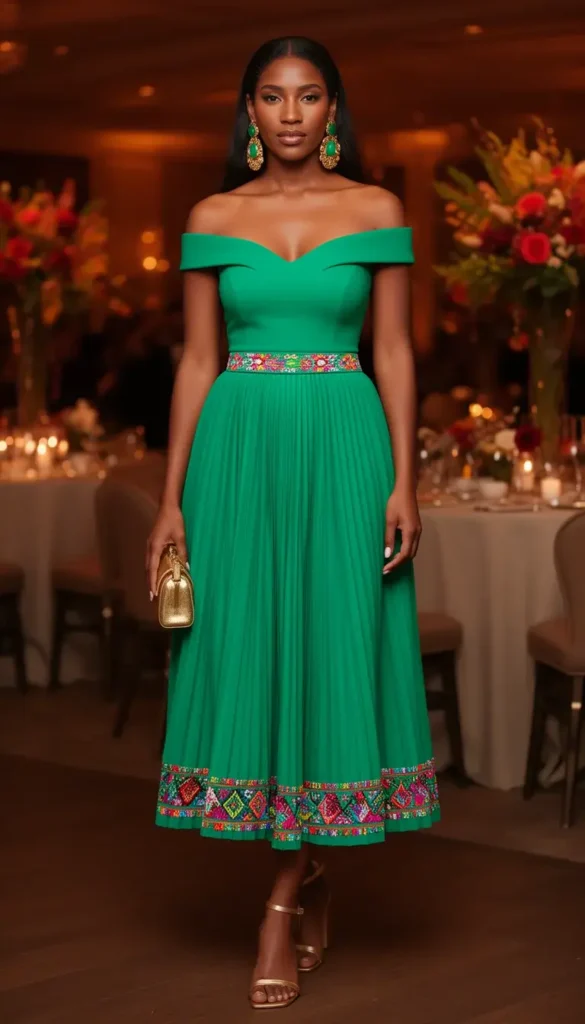
The formal Cinco de Mayo event, whether a gala dinner, a benefit, or an upscale restaurant celebration, calls for an outfit that respects the formality of the occasion while maintaining the cultural engagement the holiday deserves.
The elevated Mexican fashion aesthetic achieves this by incorporating traditional craft detail, embroidered trim, artisan-sourced jewelry, and culturally resonant color within a silhouette that reads comfortably in formal contexts.
Jade green, or verde jade, holds specific significance in Mexican aesthetic tradition, appearing throughout pre-Columbian decorative arts, Aztec ceremonial objects, and colonial-era Mexican jewelry as a color of particular reverence.
Wearing jade green to a formal Cinco de Mayo event is a color choice with genuine cultural grounding rather than an arbitrary palette selection.
The narrow embroidered trim at the neckline and hem is the detail that bridges the formal gown silhouette and Mexican artisan craft.
It’s restrained enough to read as elegant in a formal context while being distinct enough to function as a cultural reference.
That balance, present and specific without overwhelming the formality of the occasion, is what makes this approach worth pursuing.
15. Sustainable Mexican Brands as Genuine Celebration
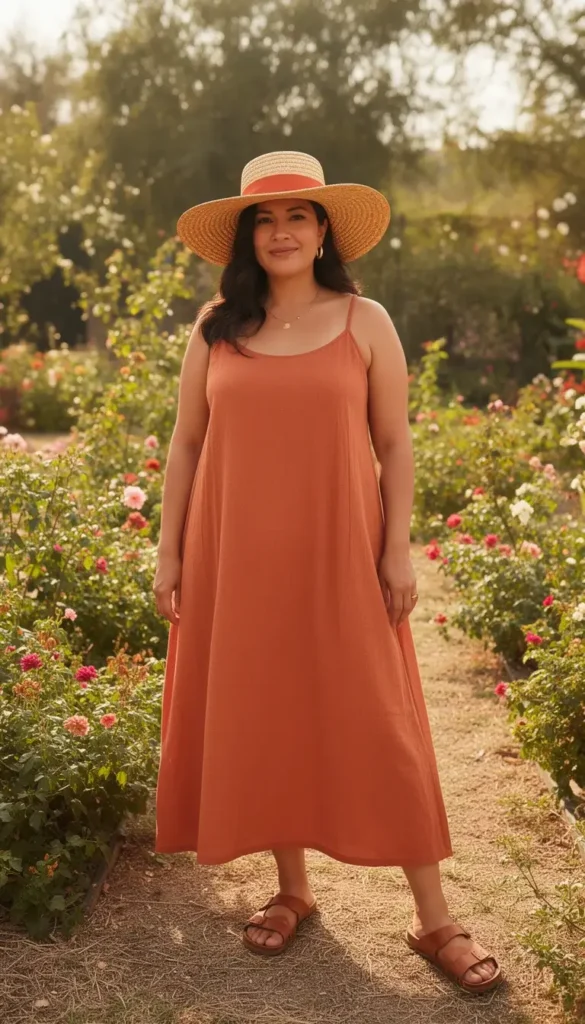
The intersection of sustainability and Mexican fashion is a rich and rapidly growing space.
Brands like Maison Miru, which works with Mexican artisan communities on ethically produced accessories, and La Double J, which has historically incorporated Mexican weaving traditions into its collections with transparency, represent a direction where purchasing power becomes cultural investment.
Closer to the source, Mexico City’s sustainable fashion scene has produced designers like Carla Fernández, whose entire practice is built around collaboration with indigenous Mexican textile makers and whose work is explicitly rooted in pre-Columbian construction techniques.
Buying a Carla Fernández piece for Cinco de Mayo is buying directly into a practice that compensates, credits, and actively sustains the communities whose traditions it draws from.
The terracotta and natural palette of this look reflects the earth tones of Mexican architecture and landscape rather than the vivid palette of festive dress, which is an equally valid cultural reference and one that reads beautifully through the long afternoon hours of an outdoor celebration.
16. Chicana Urban Fashion for the Street Celebration
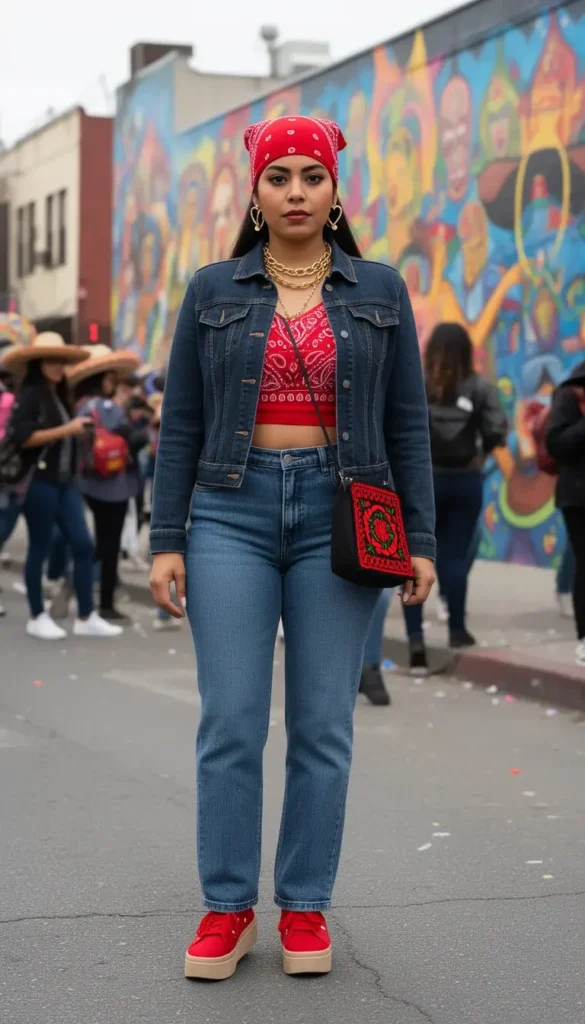
Chicana urban fashion has its own internal grammar that requires neither explanation nor apology.
The bandana print, the oversized gold hoops, the layered gold chain necklaces, the combination of denim and red, these are all elements of a fashion tradition that developed in Mexican-American communities in the American Southwest and California across decades, carrying with it references to labor organizing, Chicano civil rights, cholo and chola aesthetics, and the continuous negotiation of dual cultural identity.
The heart-detail hoop earring, the embroidered bag, the platform sneaker, these are all contemporary expressions of a tradition that has been aesthetically refined within Chicana communities over generations.
They belong to Cinco de Mayo celebrations in Chicano neighborhoods the same way a Tehuana blouse belongs in Oaxacan communities, as insider cultural expression rather than outsider appropriation.
Non-Latina women who admire this aesthetic should understand its origin before adopting it wholesale. Admiring and understanding is always the appropriate first step.
What comes after depends on the relationship, context, and ongoing engagement with the community rather than surface-level borrowing.
17. Mexican Botanical Prints as Cultural Visual Language
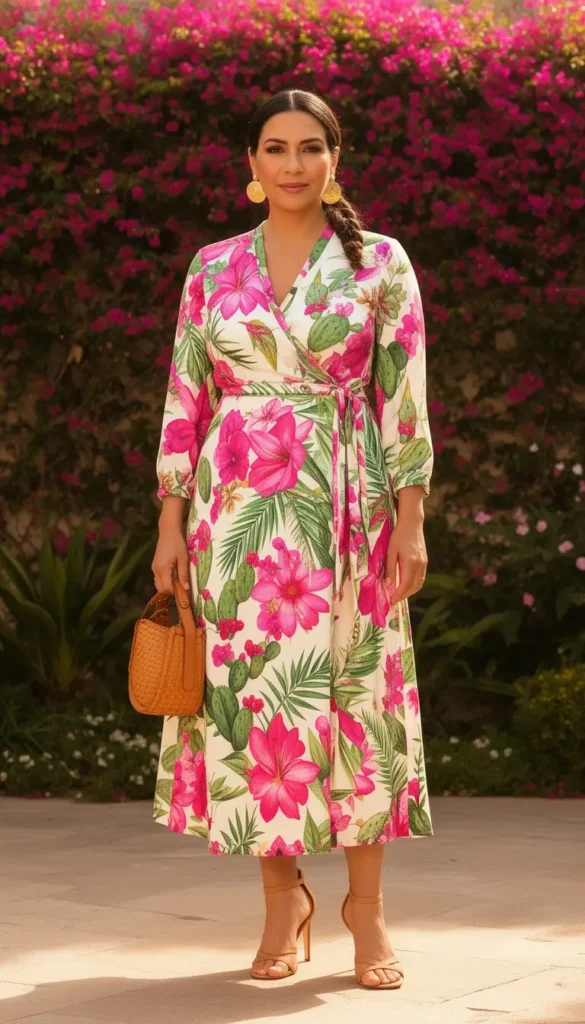
Mexico’s flora is as culturally specific as its textiles.
The nopal cactus, bougainvillea, birds of paradise, cempasúchil marigold, and hibiscus all carry specific associations within Mexican visual culture, appearing across folk art traditions, muralism, and decorative arts in ways that make them cultural signifiers rather than generic tropical decoration.
A dress that incorporates Mexican botanical references, particularly those associated with the landscape and folk art of central and southern Mexico, engages with cultural visual language in a way that generic tropical prints don’t.
The cactus flower is a visual reference to the central Mexican plateau landscape where Cinco de Mayo took place.
The bougainvillea is the defining plant of Mexican colonial architecture. Together on a dress worn to a Cinco de Mayo celebration, they constitute a thoughtful visual engagement with place.
The wrap silhouette is among the most universally flattering and practical choices for an outdoor afternoon celebration, and in a bold botanical print, it requires very little additional accessorizing.
The print carries the cultural content of the look completely.
18. Artisan Jewelry as a Standalone Cultural Statement
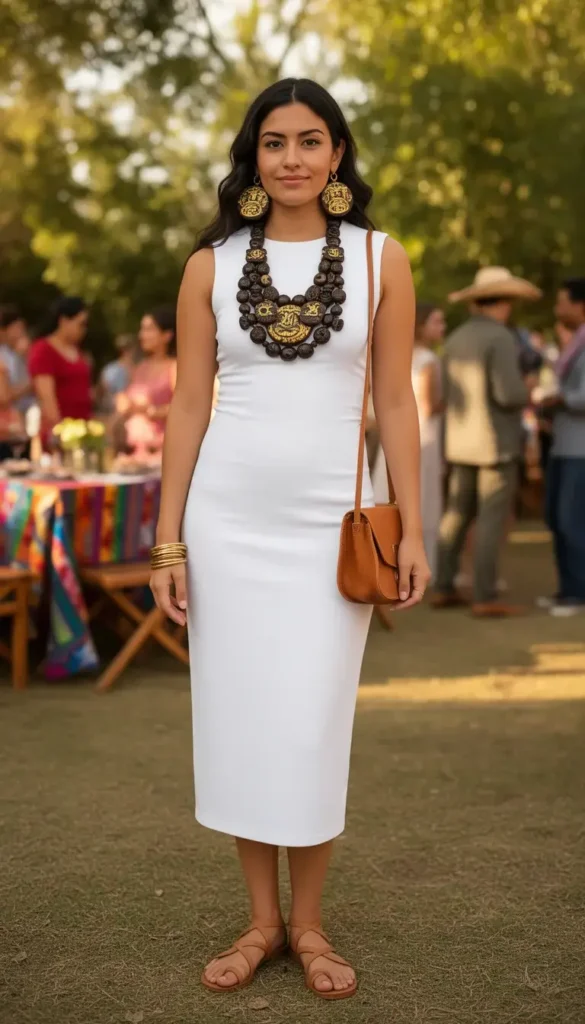
Not every Cinco de Mayo outfit needs to incorporate traditional Mexican garments to constitute respectful cultural engagement.
A simple outfit elevated by one piece of genuine Mexican artisan jewelry, whether Oaxacan hand-carved wooden beads, silver filigree from Taxco, amber from Chiapas, or hand-painted enamel from Mexico City, places cultural investment at the center of the look in a way that is entirely appropriate for women of any background who want to celebrate thoughtfully.
Taxco, Guerrero, has been the center of Mexican silver craft since the colonial period and produces some of the most technically accomplished silver jewelry in the world, with a contemporary design scene that incorporates pre-Columbian motifs into modern sculptural forms.
Purchasing a piece from a Taxco silversmith, whether directly or through a reputable importer who credits the maker, is a form of cultural support that extends well beyond the specific occasion.
The outfit underneath serves only to make the jewelry visible. White is the most reliable canvas for this purpose, creating no competition for a piece that should read as the entire point of the look.
19. Monochromatic Red as Cultural Commitment
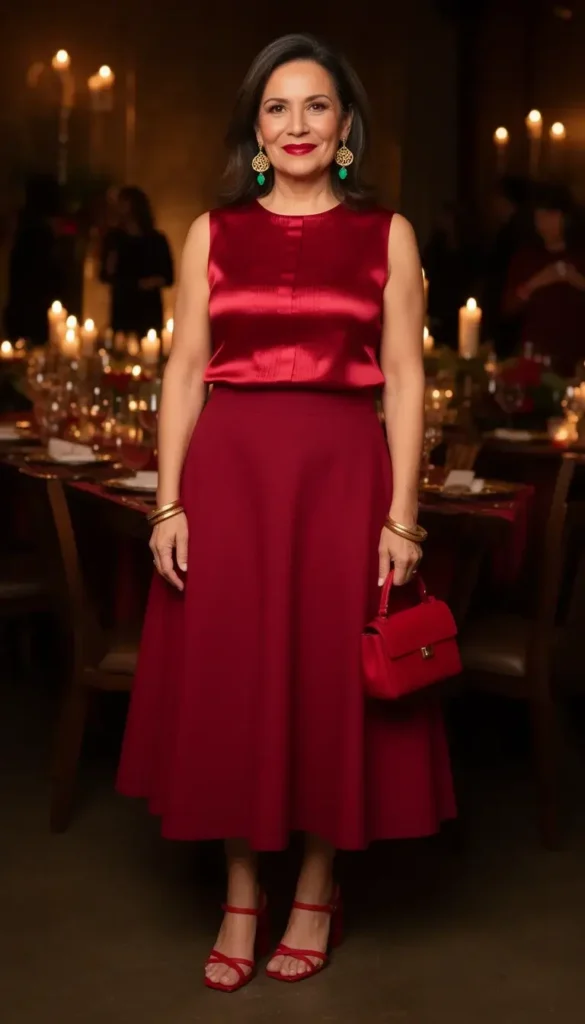
Red in Mexican visual culture is not a neutral choice. It is the color of the poinsettia, the national flower.
It is the background field of the Mexican flag’s design before the eagle and serpent appear. It runs through Mexican muralism, folk art, and ceremonial dress as a color of strength, sacrifice, and celebration simultaneously.
A completely red outfit at a Cinco de Mayo celebration is a color choice with genuine cultural weight behind it.
The monochromatic approach works here because it removes all other color decisions from the equation and allows the red itself to be the statement.
Different fabric textures within the same color family, matte cotton skirt against satin silk blouse, create tonal variation that keeps the look visually interesting while maintaining the singular color commitment.
Gold filigree jewelry with jade stone references two of Mexico’s most significant jewelry traditions, the gold work of Oaxacan Zapotec craftspeople and the jade carving traditions that predate the colonial period by millennia.
Together on a red monochromatic look, they complete a color story that is entirely rooted in Mexican cultural aesthetics.
20. Alebrijes-Inspired Prints as Folk Art Fashion
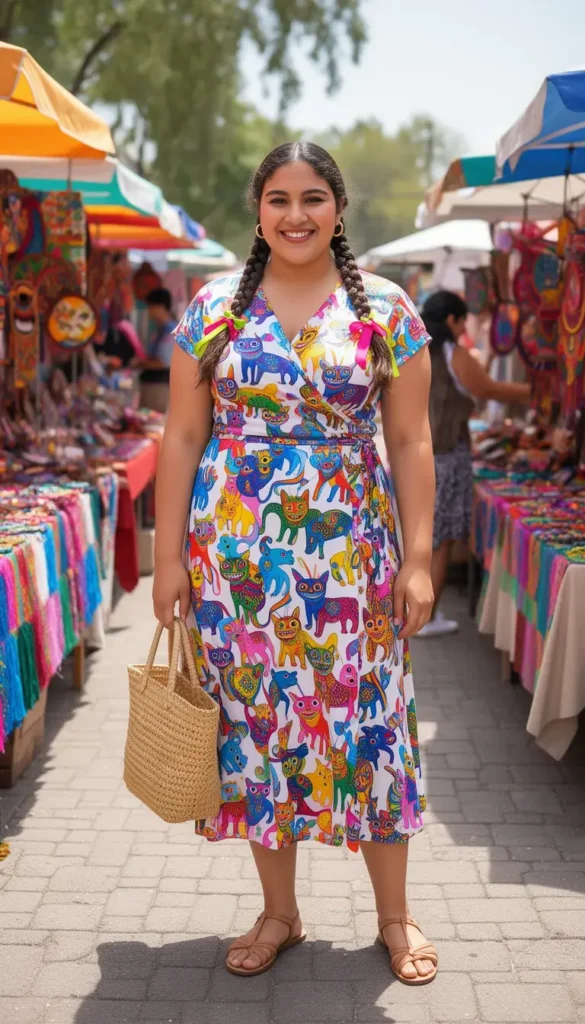
Alebrijes, the fantastical painted wooden creatures produced by carvers in the San Martín Tilcajete and Arrazola communities of Oaxaca, represent one of Mexico’s most vibrant and globally recognized folk art traditions.
Their characteristic quality is a color combination that operates outside conventional logic, a purple armadillo with yellow spots and a red tail, an orange jaguar with blue geometric markings, combinations that produce an effect of joyful visual abundance that has no equivalent in Western design traditions.
A dress printed in an alebrije-inspired pattern, particularly one that credits the folk art tradition it references and ideally has been designed in collaboration with Oaxacan artists, brings that visual logic directly into the clothing conversation.
The resulting print tends to be simultaneously complex and joyful, never muddled or confused, because the alebrije color tradition has its own internal logic that produces coherence from what looks like chaos.
This is an explicitly celebratory print for an explicitly celebratory occasion, and it carries specific cultural meaning that generic tropical or abstract prints don’t approach.
21. One Artisan Piece as the Entire Cultural Statement
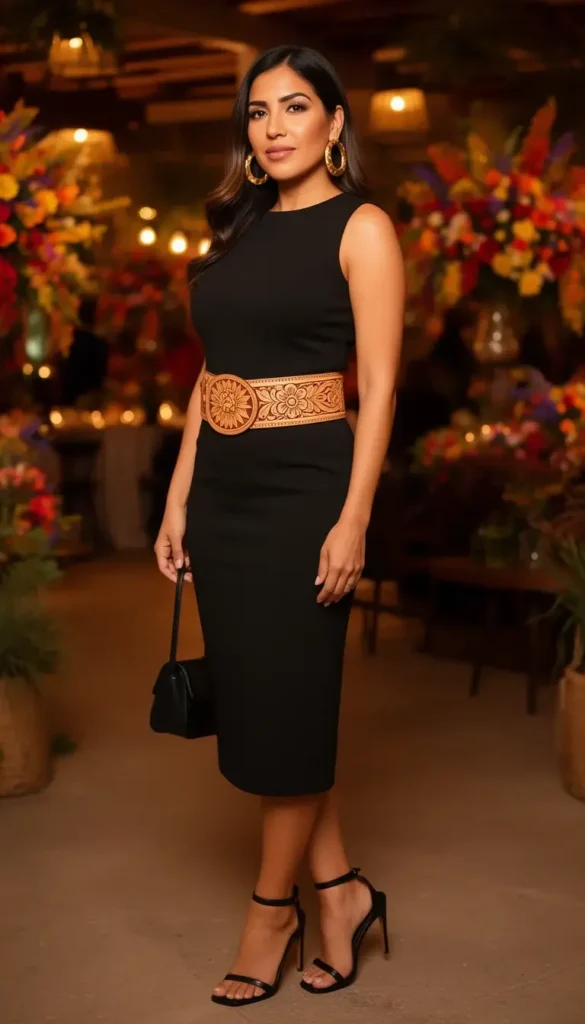
The outfit that makes a single artisan piece its entire point of view is one of the most sophisticated approaches to culturally engaged dressing available.
A clean, simple dress in black, white, or any neutral that exists only to showcase one extraordinary handmade object, a carved leather belt, a statement necklace, a hand-woven sash, demonstrates a level of aesthetic clarity that requires confidence and restraint in equal measure.
Mexican leather carving, practiced most extensively in the leather goods tradition of Jalisco and the saddle-making tradition of northern Mexico, produces belts and bags with geometric and floral surface carving of extraordinary precision.
A hand-tooled belt from a Mexican leather workshop is an object of genuine craft achievement, and wearing it as the centerpiece of an otherwise simple outfit honors that craft by making it visible rather than obscuring it with competing detail.
This approach works as well for non-Latina women as for Latina women, because it’s centered entirely on genuine respect for an artisan object rather than adoption of a cultural identity. The conversation it invites is about the object itself.
22. The Tricolor Palette Without Literalism
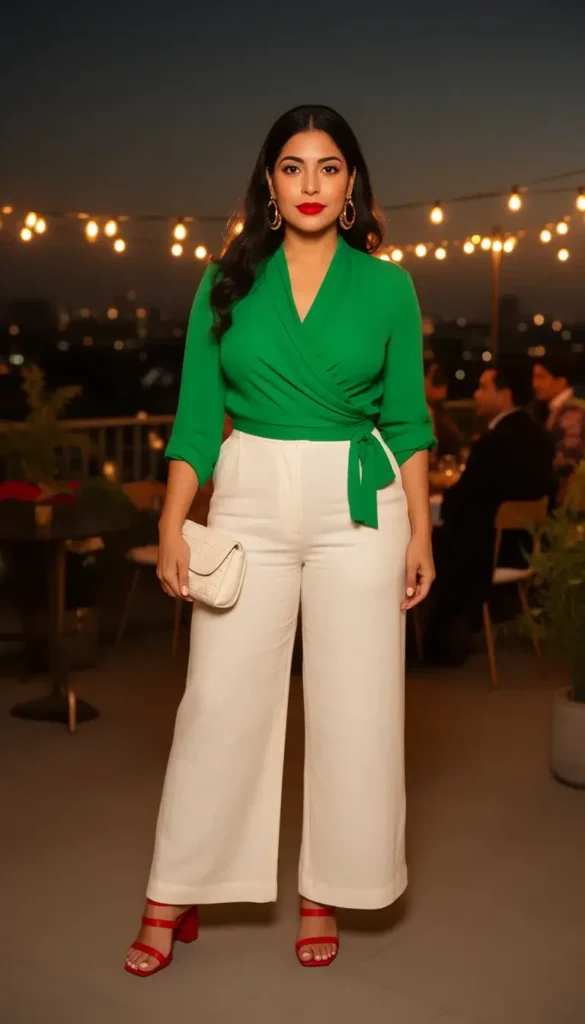
Wearing the Mexican flag colors, green, white, and red, as an explicit tribute to Cinco de Mayo, is entirely appropriate when done as a sophisticated color palette rather than a literal flag reference.
The distinction is in the execution. Separating the three colors across distinct outfit elements, an emerald green top, cream trousers, and red shoes, creates a tricolor reference that reads as a considered palette choice from a distance and as an intentional cultural tribute to anyone looking more carefully.
What to avoid is the literal, which is wearing something that looks directly like a flag.
A green, white, and red horizontally striped dress that reproduces the flag’s structure is decoration at best, disrespect at worst.
Color palette as homage and literal reproduction as costume are not the same thing, and the difference in how each reads reflects the difference in cultural understanding that produced them.
The sophistication of this approach is that it communicates clearly within a cultural context while functioning as excellent styling outside of it. This is always the mark of genuinely thoughtful cultural dressing.
23. Charro-Inspired Tailoring as Elevated Cultural Reference
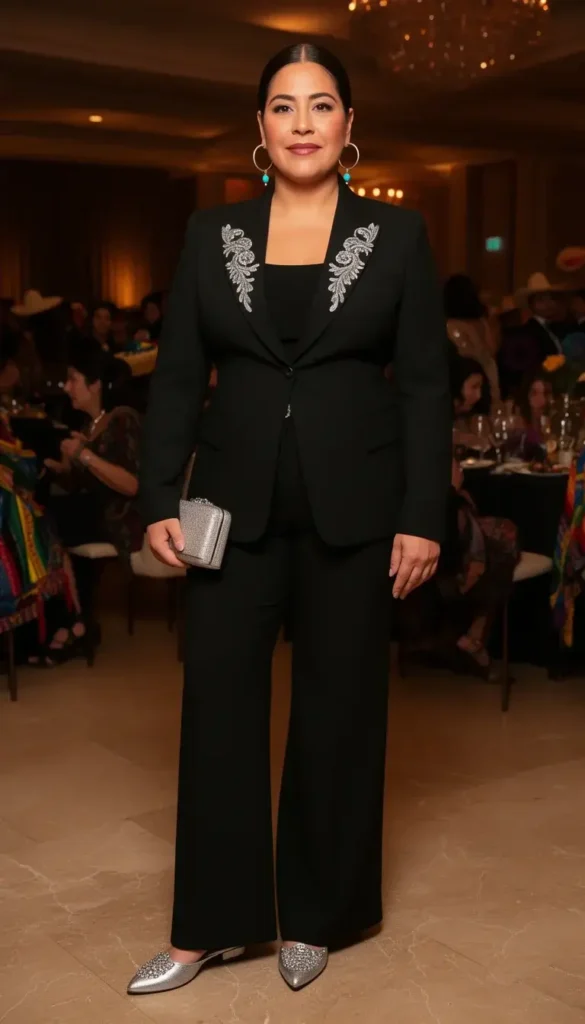
The charro suit, the elaborately embroidered and silver-adorned formal equestrian attire of Mexican charreada tradition, is one of Mexico’s most architecturally impressive garments, representing embroidery and metal decorating traditions of extraordinary technical complexity.
It’s also the origin point for the Mariachi suit, which means it carries the entire weight of Mexico’s most internationally recognized musical tradition in its silhouette.
A blazer that incorporates charro-style silver embroidery at the lapel, just enough to invoke the tradition without reproducing the full formal suit, creates a sophisticated cultural reference that works in upscale event contexts where full regional dress would read as underdressed in the wrong direction.
The rest of the look should stay clean and close to monochromatic, allowing the embroidered lapel to carry the entire cultural content.
This styling approach requires Mexican cultural proximity to execute with full authority, but the aesthetic language it draws from is specific enough and historically rich enough that understanding and articulating it is accessible to anyone willing to engage seriously with what they’re wearing and why.
24. Full Traditional Regional Dress as the Highest Celebration
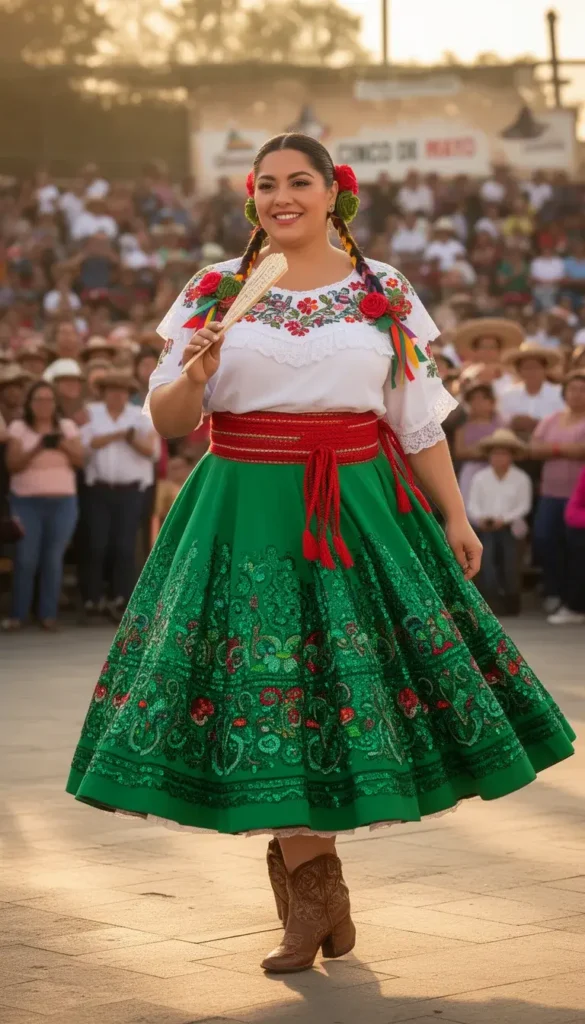
The full traditional regional dress of any Mexican state is the most complete and culturally specific form of Cinco de Mayo dress available, and it belongs without qualification to Mexican and Mexican-American women who wear it as an expression of their own cultural identity and heritage.
Nothing in this guide outranks it. Nothing in this guide approaches it in terms of cultural depth, historical continuity, or personal meaning.
The Jalisco china poblana dress, the Tehuana traje, the Oaxacan huipil worn with the full traditional complement of jewelry and accessories, the Veracruz jarocha dress, each of these is a complete cultural statement that carries within it the specific history of the region, the family, and the community that produced it.
Wearing traditional regional dress as a Mexican or Mexican-American woman on Cinco de Mayo is an act of cultural pride that requires no qualification or explanation.
This final look is included not as styling advice but as a reminder of what all the other looks in this guide are gesturing toward.
Respectful celebration, in fashion as in everything, means understanding the source, honoring the people it comes from, and recognizing that proximity to a culture is not the same as membership within it.
Dress accordingly, and dress thoughtfully. The holiday, and the people whose history it commemorates, deserve that much.
Celebrating without appropriating is not a restriction on what you can wear. It’s an invitation to dress with more intention and more knowledge than a costume ever requires.
Every outfit in this guide demands something from the wearer beyond pulling something bright from a closet, an understanding of origin, a purchasing decision that directs support toward Mexican artisans and designers, and a willingness to engage with the cultural content of the clothing rather than simply its surface.
That level of engagement is what the occasion deserves, and as it turns out, it also produces significantly better outfits.